
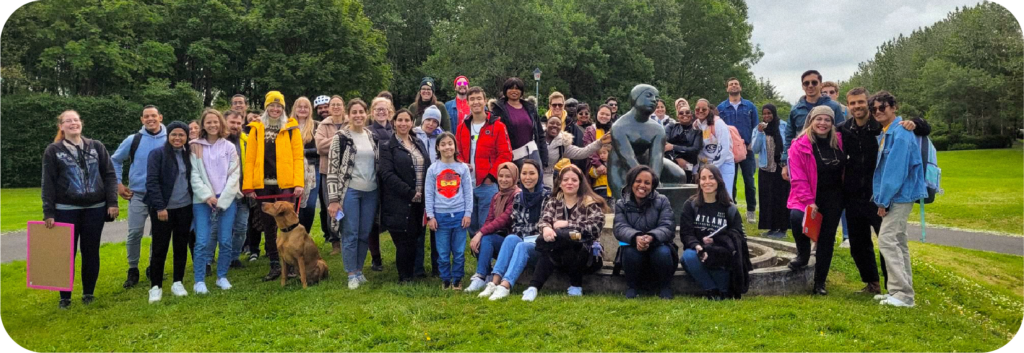
At Dósaverksmiðjan, we care about creating a warm, welcoming space built on respect and working together. Our classes bring people from all sorts of backgrounds together — taught in Icelandic, and shaped by the blend of Icelandic culture and the many cultures our students bring with them.
Dósaverksmiðjan / The Tin Can Factory is certified as an education provider by the ministry of education. We are registered there under our company name, Tungumálaskólinn ehf.
All of our courses and the class hours behind them therefore count if you are applying for an Icelandic exam for citizenship, or if you are applying for a work and residence permit with the Directorate of Immigration (ÚTL).
We teach according to the Common European Framework of Reference for Languages (CEFR). Our Icelandic courses follow Levels 1–8 (A1-B2 on the CEFR scale), as well as conversational courses Tal A, Tal B, and Tal C.
We also offer pre-CEFR courses based on the LASLLIAM framework, designed for learners who want to take their first steps in Icelandic at a slower pace. These courses focus on building strong pronunciation and vocabulary before introducing more complex grammar. They are also well suited for learners whose native language does not use the Latin alphabet. These courses are called Icelandic A, A2, A3, B, C, D, E, and Icelandic Speaking & Activities.
In addition, we offer native language courses in Arabic, Persian, Nigerian English, and Somali, depending on demand. Other languages taught regularly include Spanish and Italian.
This autumn, we are also planning on launching cooking courses in our brand-new teaching kitchen, where participants will learn to prepare a wide variety of international dishes and explore many other exciting culinary experiences.
Since 2008, all teaching at Dósaverksmiðjan has been conducted exclusively in Icelandic. As a result, equal emphasis is placed on developing listening and speaking skills alongside reading, writing, and grammar.
All of our teachers receive specialized training in teaching Icelandic through Icelandic, and Dósaverksmiðjan has developed its own learning materials for every level to ensure the best possible learning outcomes. Because listening and comprehension are the foundation of effective communication, we believe that the best way to learn Icelandic is through Icelandic itself.
Most people learning Icelandic as a second language do not have the opportunity to speak it at work. Many also have limited opportunities to practice speaking in an Icelandic-speaking environment, often because people immediately switch to English or because they know few Icelandic speakers with whom they can practice.
To become proficient in Icelandic, learners need to understand spoken language, ask questions, understand the answers, and comprehend questions in order to respond. There is a significant difference between being able to read and understand a text and having an active vocabulary that can be used confidently in conversation.
Writing coherent texts in Icelandic is also closely connected to progress in speaking, making written expression an essential part of language learning. By using a varied approach to teaching and placing strong emphasis on all language skills – listening, speaking, reading, and writing – Dósaverksmiðjan helps students achieve better learning outcomes.
Assessment is continuous throughout every course. Homework, class participation, and overall engagement are evaluated on an ongoing basis. In addition, all courses conclude with a final examination.
A student’s progress to the next course level is determined by a combination of their exam results, overall performance, and participation throughout the course. At Dósaverksmiðjan, speaking proficiency is also assessed when recommending the most appropriate next level.
We believe it is essential that every student is placed in a course that matches their ability. Enrolling in a course that is too advanced can slow overall progress and make learning more difficult. Careful placement also allows teachers to work with groups of students who are at a similar level, helping to maintain a high quality of instruction. No teacher can effectively teach a class where students have a very wide range of abilities, and when a student is placed in a course that is beyond their current level, it can slow the pace of the class and affect the learning experience of everyone.
All teachers at Dósaverksmiðjan work with us on a long-term basis, whether they are permanent employees or contractors. Before they begin teaching, every teacher completes a month of training, where they become familiar with our teaching materials, teaching methods, and our approach to teaching Icelandic through Icelandic.
Morning courses are taught over four weeks, Monday through Thursday. Fridays are dedicated to teacher workdays, during which staff review the previous week, plan upcoming lessons, develop teaching materials, and participate in ongoing professional development.
Every fifth week is a planning week. During this time, teachers prepare for the next course period, take part in continuing education, and work on course planning and the development of teaching materials.
Evening courses run for six weeks. Once a week, all evening teachers meet to discuss upcoming lessons, address any challenges, and share ideas about course content, teaching methods, and educational philosophy.
Every seventh week is a planning week for evening teachers. This time is used to prepare the next course period, participate in continuing professional development, and further develop teaching materials, teaching methods, and pedagogical approaches.
Dósaverksmiðjan employs around 40 staff members representing 9–10 different nationalities. Our youngest team member is 18 years old, and our oldest is 70, reflecting the diversity and experience of our community.
In 2025, Dósaverksmiðjan was awarded the European Language Label for the project Literacy is the Key to Democracy. The award recognized the school’s LESLLA programme and its development of teaching and learning based on the LASLLIAM language framework.
The programme is designed for learners whose native language does not use the Latin alphabet, as well as for those who wish to begin learning Icelandic at a slower, more gradual pace.
Dósaverksmiðjan offers LESLLA classes both during the day and in the evening, with approximately 1,000 students enrolled in the programme each year.
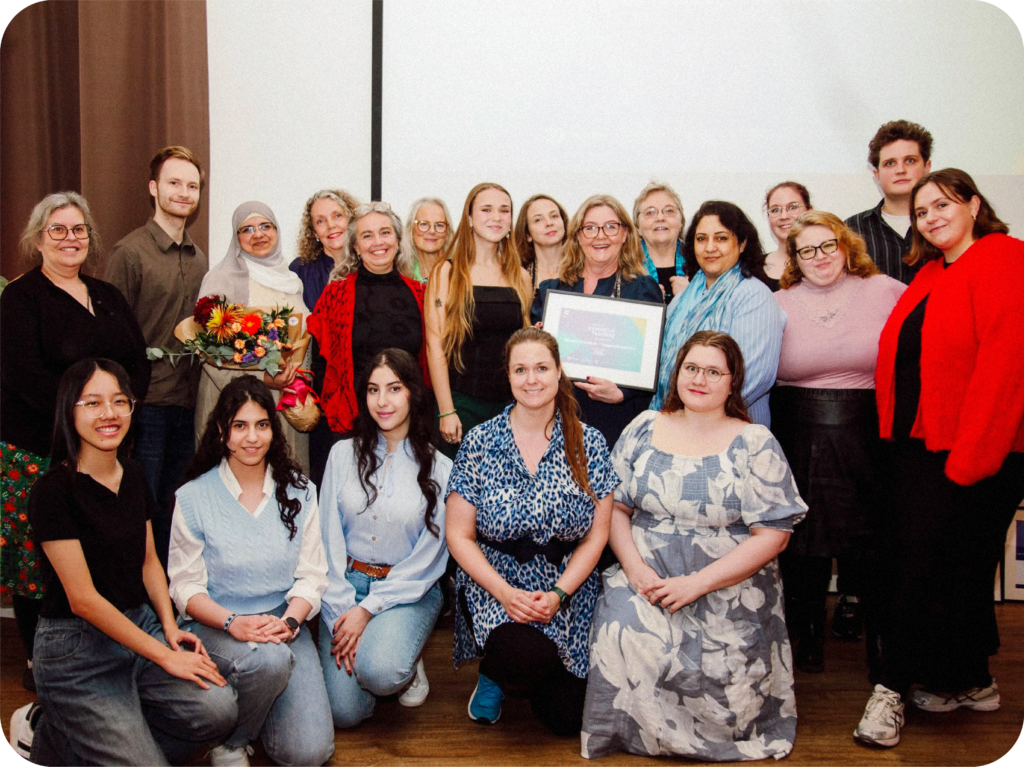
Some of the teachers working in Dósaverksmiðjan’s LESLLA program.
A major part of Dósaverksmiðjan’s work is developing course materials. Some of this material has been published; other material is awaiting publication due to a lack of funding for producing course materials.
Course materials published by Dósaverksmiðjan
The following teaching materials were written by Dósaverksmiðjan’s educational specialists and published by the Icelandic Centre for Educational Materials (Miðstöð menntunar og skólamála):